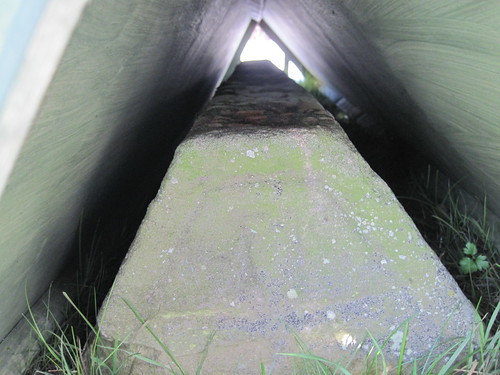
On either side of the Northern end of the demolished viaduct is a type 23 Pillbox.
The western one is on an accessible part of the walkway


The eastern example is in a private field, so no close-up.

Thorpe Thewles Viaduct Remains
The 1877/78 Thorpe Thewles viaduct was demolished spectacularly in 1979

This stone outside the village is part of the structure.

At the top of an embankment overlooking the village are a few scant remains of the viaduct

St. James Church, Thorpe Thewles
St James Church was built in 1886-7 on the site of the short lived Holy Trinity Church of 1848

The font outside is originally from St. Thomas a Becket’s church in Grindon.
Thorpe Thewles – Roger De Fulthorpe Grave Cover
This is one part of Teesside that’s remaining hidden at the moment, the grave cover is currently covered for its own protection.

The stone was originally in St. Thomas a Becket’s church in Grindon

This photo from the Thorpe Thewles History Group shows a comparision betwen 1940 and 2007 and the rapid deterioration of the inscription.

The group are hoping to start a conservation project this year, so hopefully it will soon be on view again.
Thorpe Thewles Pillbox
Spalted Hamadryad, Hardwick Park.
This chainsaw sculpture is by Tommy Craggs
A Hamadryad being a greek mythological being that lives in a tree.
Hardwick Park – Serpentine Bridge
Temple of Minerva – Hardwick Park
The temple is dedicated to Minerva goddess of wisdom and the arts and was originally constructed between 1754 and 1757.

The niches on each side contained busts of Homer, Virgil, Horace, Milton, Shakespeare, Ben Johnson, Dryden and Pope.
It’s fascinating to see this picture from 2004 when the site was a ruin before restoration.
© Copyright Neil Atterby and licensed for reuse under this Creative Commons Licence
Gothic Seat – Hardwick Park
Gothic Ruin – Hardwick Park
Hardwick Park was laid out by John Burdon in the 1750s, this folly from 1764 was built with stone from Guisborough Priory


The buildings were genuinely ruined until a Heritage Lottery Grant allowed their restoration as this photo from 1972 shows.
© Copyright Stanley Howe and licensed for reuse under this Creative Commons Licence