Captain Cooks Family Grave

Geotag Icon Show on map

All Saints Church in Great Ayton contains the graves of James Cook’s mother and five of his brothers and sisters.
Captain Cooks family grave
My interpretation of the inscription :-

“To the Memory of Mary & Mary, Jane & William.
Daughters and Son of James and Grace Cook.
Mary died June the 30th 1737 in the 5th year of her age.
Mary died June the 17th 1741 aged 10 Months & 6 days.
Jane died May the 12th 1742 in the 5th year of her age.
William died July(?) the 29th 1747/8 aged 2 yrs 12 months 16 days 7 hours.
and also John their son died Sept the 20th 1750 aged 23 years”
Captain Cooks family grave, Grace Cook

“In memory of Grace Cook who died Feb 18th 1765 aged 63 Years and of James Cook who was buried at Marske April 1st 1779. The above James and Grace Cook were the parents of the celebrated circumnavigator Captain James Cook who was born at Marton Oct 27th 1728 educated in this village and killed at Owhyhee Dec. 14th 1779″

This inscription is actually incorrect as Cook was killed on Feb 14th 1779

Captain Cooks family grave

Cooks father is buried at St Germains in Marske

Obelisk at location of Captain Cooks family cottage – Great Ayton

Geotag Icon Show on map

This obelisk marks the location Captain Cooks family cottage.
Captain Cooks Cottage Obelisk - Great Ayton
The cottage itself was shipped to Australia for the Centenary of Melbourne in 1934 where is still stands in Fitzroy Park. The cottage was built by Cooks parents in 1755 so its unlikely Cook himself actually lived there as he moved away to Staithes in 1745.
Captain Cooks Cottage Obelisk - Great Ayton
The obelisk is constructed with stone from near Point Hicks which was the first part of Australia spotted by Lieutenant Hicks from the Endeavour. It is a replica of an obelisk that stands there.

The unveiling of the obelisk was actually captured and is available on the Pathe Website.

UPDATE : A friend of mine has recently visited the cottage in Australia, so many thanks to Eric for the photo.

Ayton Monument Ironstone Mine

Geotag Icon Show on map

Ayton Monument was worked for 23 years between 1908 and 1931 by Pease and Partners, the site is now in regular use as a offroad bike circuit.
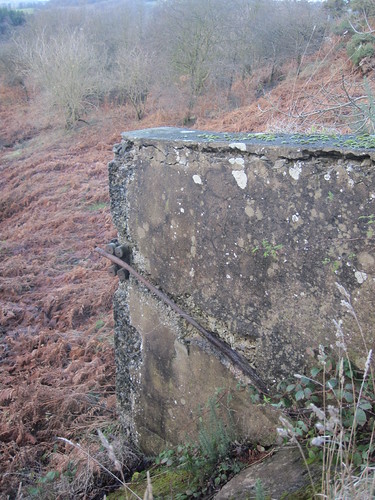
This beautifully carved stone dates from the building of the main hauler engine house.
Ayton Monument Ironstone Mine
An sirocco fan was installed to ventilate the mine in 1919, the date is still visible on the remains of the fanhouse.

Ayton Monument

At the top of the steep incline up to the site are the foundations of the braking drum.

Ayton Monument
At the base of the quarter mile long incline which provided a link to the railway is a intact electrical substation for the mine from around 1921.
Ayton Monument Incline  Monument Sub-Station

Ayton Banks Ironstone Mine

Geotag Icon Show on map

Ayton Banks was mined by three different companies between 1909 and 1929, it was a small royalty entirely enclosed within Ayton Monument mine.
The most obvious remains are the numerous shale heaps, some with ironwork on top probably from aerial ropeways.

Ayton Banks Ironstone Mine

A number of building remains and foundation can be spotted in the dense undergrowth

Ayton Banks Ironstone Mine Ayton Banks Ironstone Mine  Ayton Banks Ironstone Mine

A very small length of drift is visible at the bottom of a large collapse, but its tricky to reach and also flooded.

Ayton Banks Ironstone Mine

About 100m to the south of the drift, iron stained water can be seen emerging from what was presumably a drainage level, this appears to be lined with corrugated iron sheets which have collapsed a few feet in, water can again be seen at the bottom of that collapse.

Ayton Banks Ironstone Mine  Ayton Banks Ironstone Mine

Victorian Urinal and bridge dedicated to Ironstone Miners

Geotag Icon Show on map

The bridge into Waterfall Park in Great Ayton is dedicated to five ironstone miners who lost their lives in the First World War.
Great Ayton Bridge
The under manager George Whitbread worked at Ayton Monument rather than Ayton Banks.

Over the bridge is a cast iron Victorian Urinal, it was originally one of three, it moved here in 1998 from Station Road.
Great Ayton Urinal